
A good friend of mine who I don’t talk to very often, asked me today what I liked about living in Mexico and what I missed about the US. The truth is, I miss you — my friends — the most. Other than that, maybe better roads and cleaner streets. Otherwise, I love living in Mexico.
If only time and money weren’t obstacles, I would visit you all more often. Of course, you are spread out across the country, which complicates things, too. That said, however, only a few of you have actually taken the time to come and visit me here, in a place where millions of Americans go each year for their winter vacations. What is that? We are only a car ride away from Cancun and the fancy beach resorts that you guys love. And, we are in a city that is brimming with history, culture and gastronomy. Merida has fantastic colonial architecture, amazing archeological sites, and some of the best food in the country. So why aren’t you coming here?
It’s the people
On the other side of the coin is the question, what do I like about living in Mexico. Well, there are many reasons. I love it here primarily for the people. They are the most welcoming and warm people I have ever met. They say hello with a kiss, even if they have just met you. Of course, some of that custom went away during the pandemic, but it has resurged since.
Unlike the US, where being different makes you the enemy, here, being different makes you unique and interesting. Everyone you meet wants to know about you and where you are from. “Mi casa es su casa” isn’t just an expression; it’s a lifestyle.
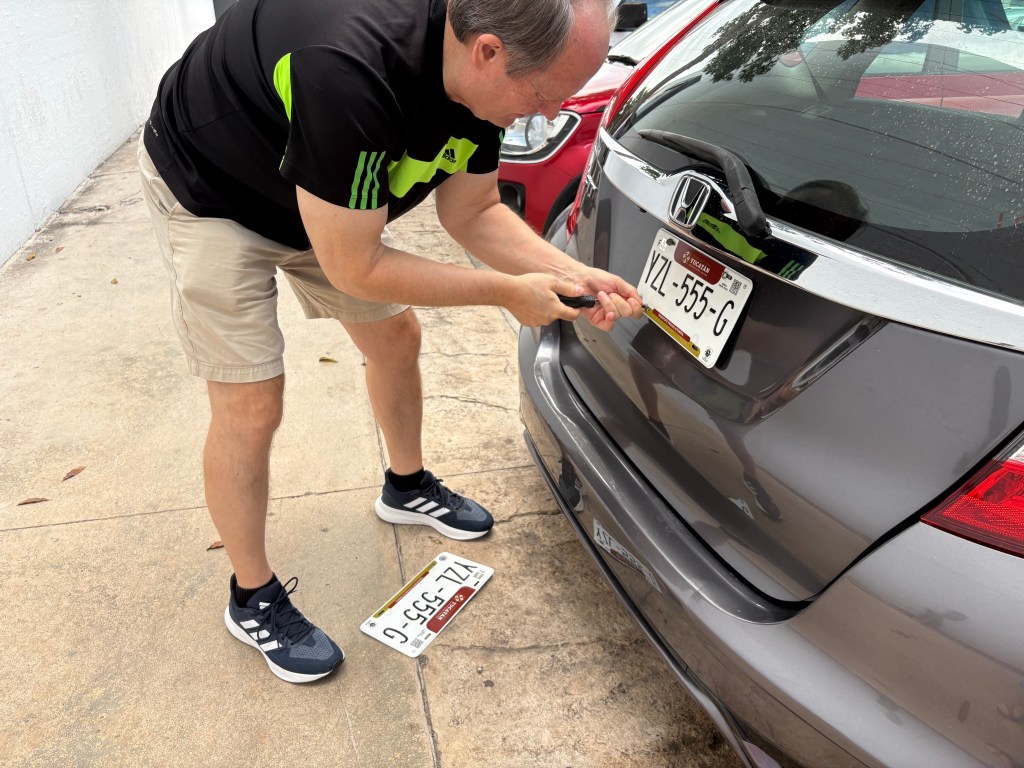
Obviously, every part of the country is a little different, but I have never felt discriminated against here. In fact, people go out of their way to help you. For example, this year, the state of Yucatan required all vehicles to get new license plates. The process was complicated and included uploading many documents onto a government website that was only in Spanish.
My Spanish skills have improved greatly over the years we have been here; however, these types of things can be much more complicated and technical. Needless to say, I wasn’t able to do it the first time around. In fact, I didn’t even realize I HAD TO until one of my friends here told me it was the law. That forced my hand, and I had to try to figure it out.
After the first debacle, I started asking everyone I could what I needed to do. Believe it or not, but it was the receptionist at the doctor’s office who took on the task of researching it for me and ultimately sending me the instructions. Nevertheless, my first attempt to make an appointment to get the new plates failed, and I couldn’t understand what I had done wrong (dang Spanish!).
Then a friend of mine offered to help me. I sent her all the documents she requested, but the response was that I had already started the process, making it impossible for her to do it for me.
Grrrr.
Ok, so I went back online and reviewed the page that laid out my errors and attempted to fix them. Guess what? Voila! It worked! I was able to pass to the next step, which was getting an appointment to actually pick up the new plates.
So, yesterday I went to the designated government office to get my new license plates. In the past, it has taken HOURS of waiting in multiple lines only to be told I was missing some key element. Remember, it took eight visits to the SSP (state police) to finally get my first set of Yucatan license plates. Every visit involved at least four hours of waiting.
But yesterday, I arrived early for my 10:15 appointment and was actually done and out of there by… wait for it … 10:15! The lines weren’t too long and the process was well organized. The first step was for them to check and scan your documents (official ID, car title, and current insurance policy). The second line was where they actually handed you your new registration card and license plates.
The man who helped me had a name plate that said “Lic. Derechos.” I asked him what that meant, and it turns out he is a lawyer that can help with your legal rights, i.e., if you are having trouble navigating the system, he has the power to actually help you. I explained to him that things like this process were a bit complicated for me, but that I found the process this time to be very efficient. He was quite kind and said that they worked hard to improve the process, and he complimented me on my Spanish. (wow).
The whole thing took about 20 minutes.
Lots of things to see and do
I’m not the best at wandering on my own. Thankfully, my friends are great at finding things to do and inviting me to go. For example, as you saw on my last blog post, the Paseo de Animas. I also just received an invite to go to a concert in the park to present the new director of the symphony. I have gone to the symphony with friends several times now. The Palacio de la Musica is a beautiful facility and the ticket prices are quite low (about $10 US).
The park — La Plancha — is relatively new. It takes up about five blocks downtown and includes a huge food court, an amphitheater, a train museum, a lake with one of those fancy fountains that change colors and dance to the music, plus areas for children to play and people to walk. It is quite lovely and easy to get to being right in the center of the city.
There are also concert halls, a zoo and many parks and sports centers around the area.
Transportation is good
If you don’t have to drive and don’t want to pay for an Uber, you can get around the city fairly easily using the Va y Ven bus system. The fares are so low!! $12-18 pesos (apex. $0.50-$1.00 US) for adults, and people over 60 get a discount, so pay just 5-8 pesos ($0.25-$0.35 US). And it goes all over the city! The buses are clean and air-conditioned, and many are hybrid or electric.
Of course, people still prefer cars, if they have one, since bus travel is always slower. The downside of driving, though, is the quality of the roads. There are potholes everywhere! In fact, a month or so ago, Lyn and I hit one and our tire virtually exploded!
The road conditions are difficult here due to the weather. The super high temperatures in March and April, and heavy rains in summer make maintaining them a nightmare. The periferico, which is the main highway that circles the city, if fairly well maintained most of the time. We live close to it, which makes getting around a little easier.
The city is laid out like a spider web, though, so if you have to get anywhere downtown, it will take you at least 20-30 minutes, even though the driving distances aren’t long.
It is inexpensive to live here
One of the key reasons we love it here is the cost of living. We do very well with an income of about $1,000 US per month. We did buy a house and paid cash, which helps, but, again, housing costs are low. Our house — two bedrooms, 2 1/2 bathrooms, with a swimming pool, cost us about $130,000 US, which was the equity we had in our Boise home that we sold. So, with that, we could buy a house just a little smaller without a mortgage. Mortgages are not typically available to foreigners, and, even if they were, the interest rates are astronomical — like 14%.
If you are a Mexican and working at a corporation that participates, you may be eligible for a government funded mortgage called Infonabit. They offer workers better rates which allows them to buy a home and sometimes more than one. This is a wealth-building opportunity for them. Most of the people I know own more than one house. The other way for people to afford housing is through inheritance. The larger, older homes are often passed down through the generations.
When we built the house, we invested in solar panels too, spending about $5,000 US. It has been the best investment as our total yearly electric bill is about $200 US. Really!!!!! Because of the heat, we use our air conditioner ALL. THE. TIME. Without the panels we would be paying more than five times more.
We are on a well, so no water bills. We only have two gas appliances — the water heater (which is instant) and the stove/oven. We have a propane tank on the roof which holds about 30 liters. That gets us through three to four months!
The biggest expenses are around the car — insurance is about $500 per year, gas is another $50 per month — and groceries. Food prices have been going up, but nothing like what they are in the states. We typically pay about $100-$150 US each week for groceries.
Health care
Medical expenses are very affordable. Most medications don’t require a prescription (except antibiotics and controlled substances). For me, I probably spend about $50 US every two months on my meds (blood pressure, thyroid, allergy). I have been going to a dermatologist to get rid of some sun damage spots, which has added a bit to the expense, but it is so worth it! A laser treatment here is about $175 US.
A typical doctor’s appointment with a private doctor runs around $50-$100, depending on the physician. Specialists are a bit more, but not much. Remember, too, that my 4-day stay in a private hospital last year only cost $3,500 US.
From what I understand from my Mexican friends, if you need something special, like chemo therapy or surgery, it can amount to a lot more.
Health insurance is available, but not for people over 65, which means us. There are options for expats that include travel insurance and high-deductible plans, but they don’t appear worth it (in my opinion). We are pretty health and, at this point, don’t use many services that would necessitate using it.
IMSS, the government medical system, is free to people who are employed and contributors (sort of like Social Security). It offers coverage to others for about $1,000 per year, but you have to deal with the bureaucracy. The good part is that coverage includes medications and all the specialists, etc., but the hospitals are overcrowded. So far, we have used the private hospitals, like Star Medica and Faro, which provide great services at reasonable prices (compared to the US, that is).
The caveat
I hope you can see that, as an expat, there are great financial advantages to living here. The issue is that the Mexican people don’t earn nearly as much here, with typical salaries of around $500 per month. Managers, engineers, and professionals earn more, but the people who do the best are business owners. The tax system is complicated and corruption is well-documented. It is easy to understand why people want to go to the US; every opportunity they see on TV, even the hardest jobs such as working the fields harvesting crops, offers more money than they can possibly earn here. And they are willing to make huge sacrifices to earn it, often leaving their families behind and living in terrible conditions just so they can send as much money home as they can.
Personally, I couldn’t do it. These people accept harassment and discrimination willingly in order to help their families and, in doing so, help the US by providing cheap labor. How do we reward them? Well, don’t get me started on the current policies of the US.
AND NOW….
Thanksgiving!!!!!
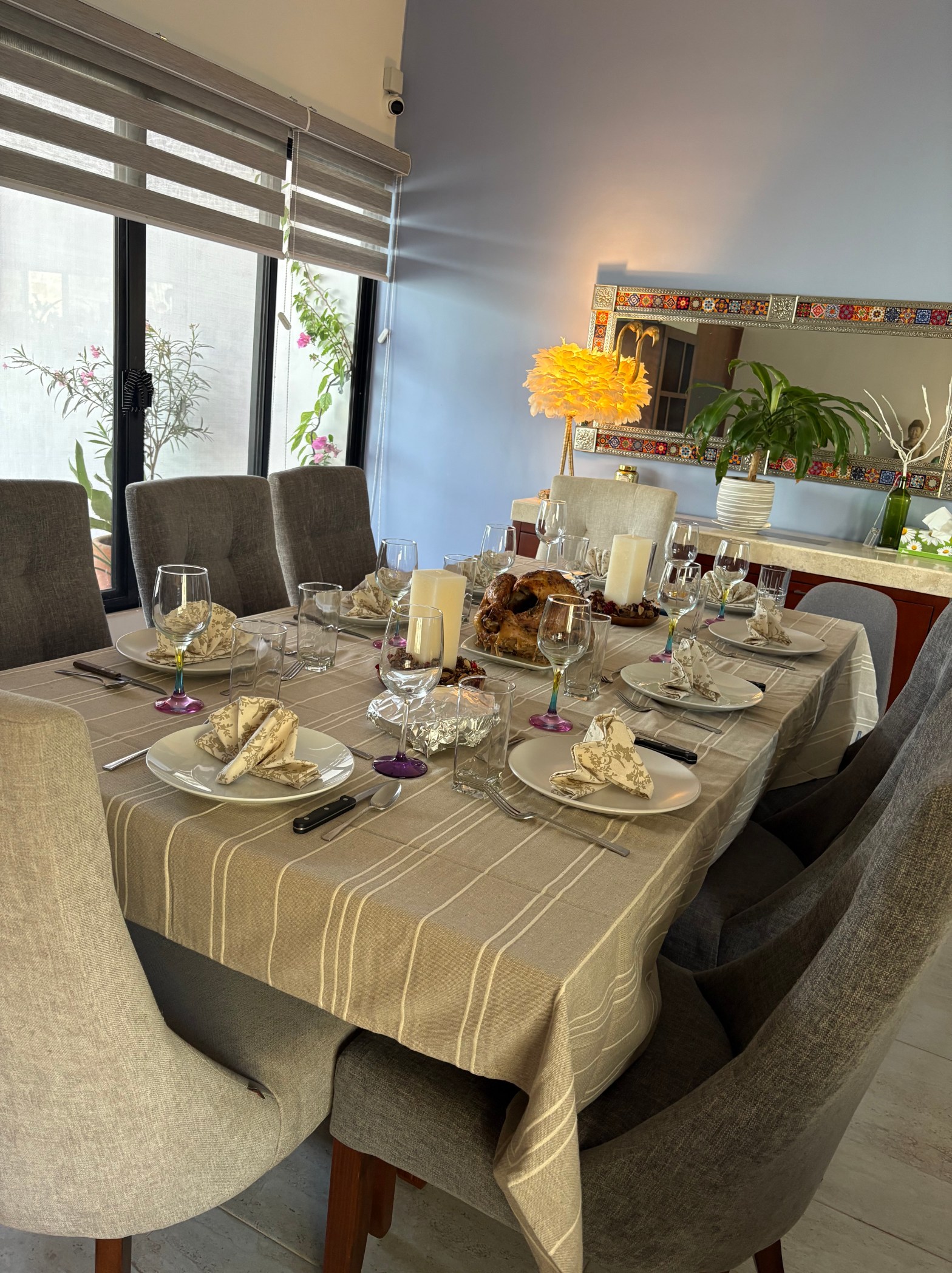
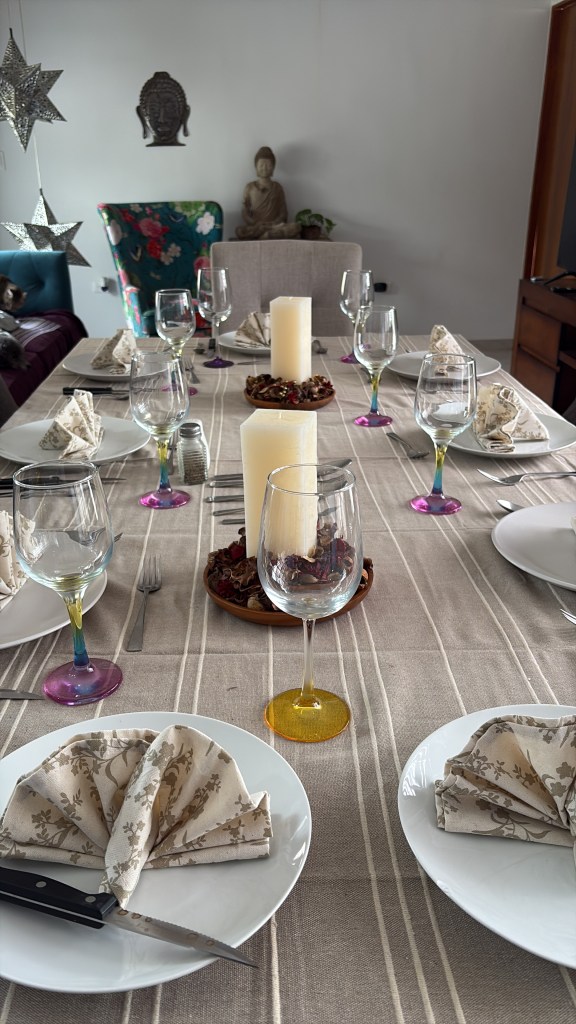
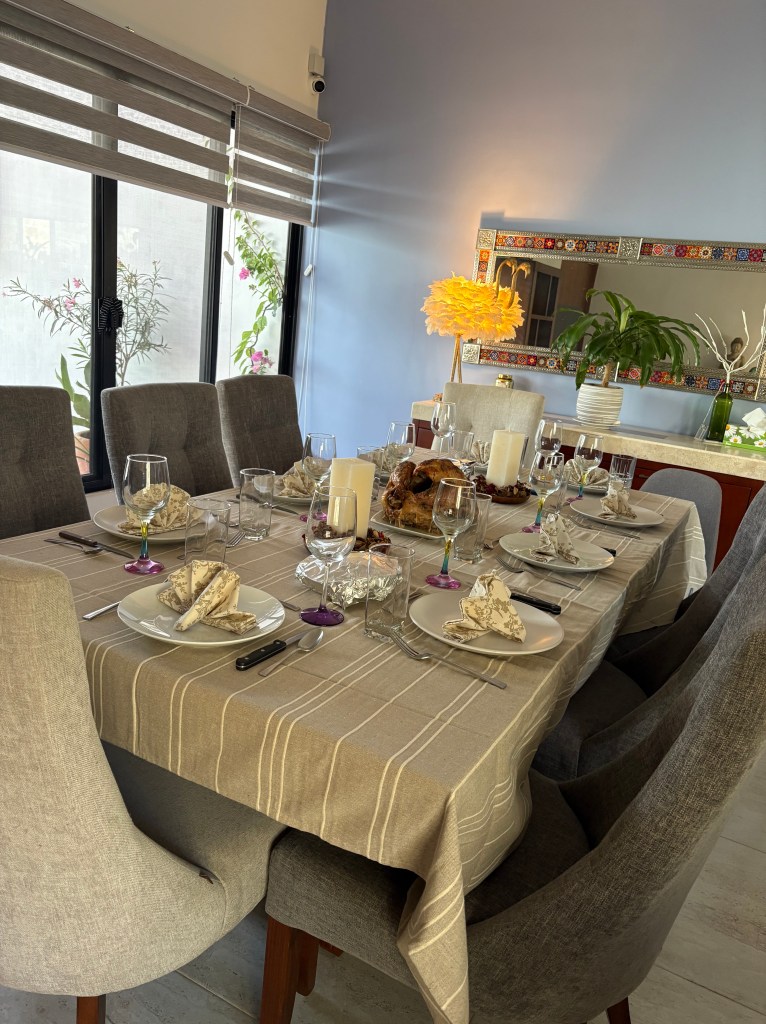
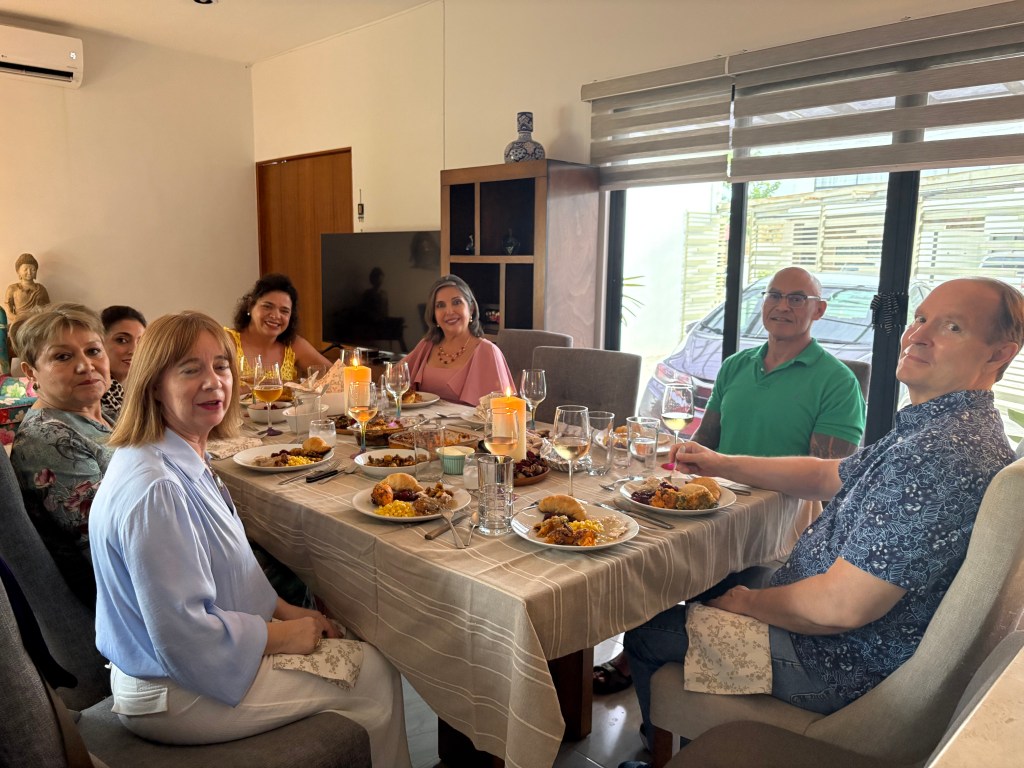
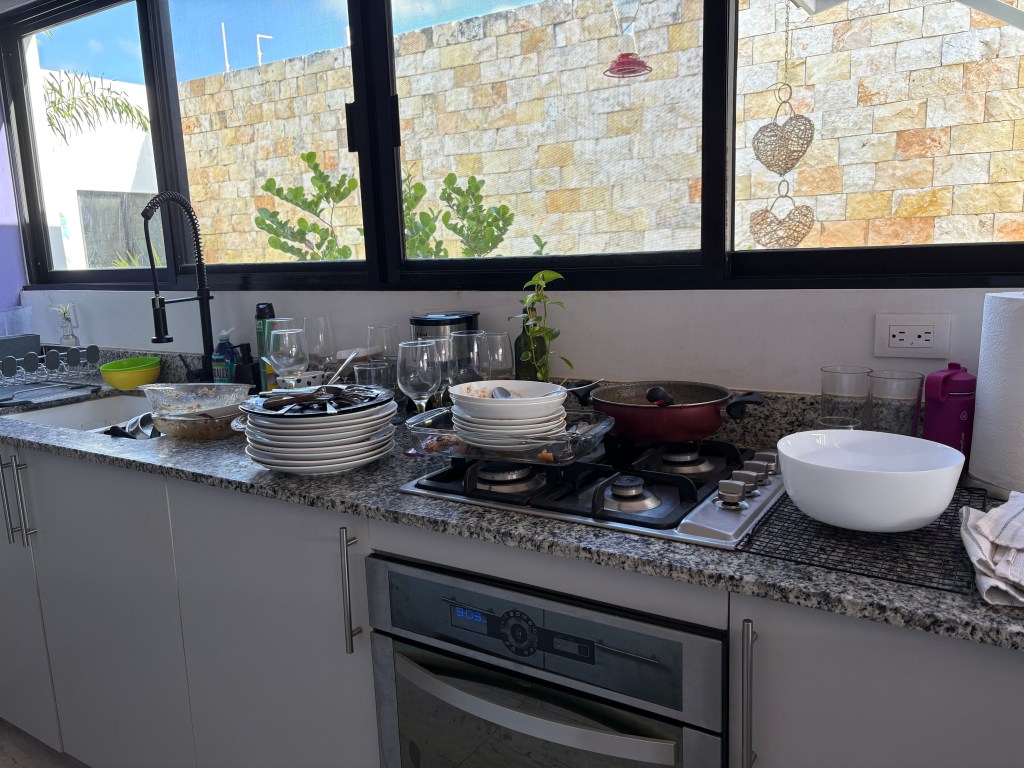
Our celebration was a huge success! All of the food was delicious and the table looked lovely. It was a lot of work. I cooked for three days and cleaned up for another two. I might do it again (in another 10 years)!
PICTURES!


We sent some leftovers home with Yasmin for her cats, too. They loved it as well!


Well, that’s it for now. Stay well and come visit!!!!!
Donna
 donnageisler.com
Thanks for the interesting letter! Glad to hear you are doing well and enjoying living in Merida!
Kim
LikeLike
When are you coming to visit?
LikeLike